
From ESA Spark Funding to the Hera Mission: Czech Company i46 Takes Its Cybersecurity Technology into Deep Space
Prague-based innovation company i46 s.r.o. has been selected by the European Space Agency (ESA) to test its post-quantum cybersecurity technology aboard the Hera deep-space mission. The achievement marks an important step in the development of SpaceBox, an innovative secure data-storage concept previously supported through the ESA Spark Funding programme by ESA Technology Broker Czechia at Technology Centre Prague.
I46 will port core post-quantum cryptographic algorithms—specifically NIST-standardized ML-KEM-768 alongside AES-256-GCM—from its SpaceBox data vault directly onto Hera’s flight processor. The aim is to prove that quantum-safe data sealing and replay-resistant command authentication can operate reliably beyond Earth’s protective magnetic field, where cosmic radiation can induce bit flips that threaten cryptographic integrity. Following software preparation and qualification to strict space engineering standards, the experiment is scheduled to execute on board Hera during a four-week campaign in August 2027, marking the first in-flight demonstration of ML-KEM on ESA deep-space hardware
The project demonstrates how technology originally developed for applications on Earth can be adapted for use in space, opening new opportunities for Czech companies in the European space sector.
From ESA Spark Funding to the Hera mission
The collaboration began in December 2025, when i46 submitted its SpaceBox project proposal to ESA Spark Funding Czech Republic, managed by Technology Centre Prague.
SpaceBox was proposed as a spin-in project, meaning that technology developed outside the space sector would be adapted for space applications. The project builds on i46's existing DISK46 cybersecurity technology and aims to develop a highly secure data vault capable of protecting sensitive information and cryptographic keys using space-based computing infrastructure.
In February 2026, the SpaceBox proposal passed the ESA Spark Funding evaluation, subject to conditions related to industry partnerships, future in-orbit demonstration and project financing.
Throughout this initial stage, ESA Technology Broker Czechia, operated by Technology Centre Prague, supported the technology-transfer process, administering the ESA Spark Funding selection procedure, coordinating with the company on project requirements and helping prepare the pathway towards future space applications.
On 20 November 2026, i46 announced another significant milestone: its selection under ESA's Open Space Innovation Platform (OSIP) to conduct the PQVault-Hera experiment aboard ESA's Hera spacecraft.
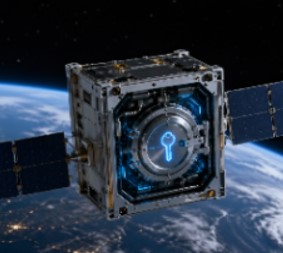
What is SpaceBox, and why is it important?
SpaceBox is a cybersecurity solution designed to protect highly sensitive data, encryption keys and digital credentials against unauthorised access and emerging cyber threats, including those associated with future quantum computers.
The concept is to adapt existing terrestrial encryption and key-management technology for operation on space-based computers, creating a highly isolated environment for secure data storage and access control.
Such technology could eventually be valuable for critical infrastructure operators, financial institutions, satellite systems and other organisations requiring long-term protection of sensitive information.
The Hera experiment represents a focused next step in validating this technology. Rather than sending a complete physical SpaceBox device into space, i46 will adapt selected cryptographic software functions for execution directly on Hera's existing onboard computer.
The experiment will use the NIST-standardised post-quantum algorithm ML-KEM-768 alongside AES-256-GCM encryption. It will investigate whether quantum-safe data protection and authentication mechanisms can operate reliably in deep space, where cosmic radiation and other environmental conditions can affect computer systems.
Following software preparation and qualification, the SpaceBox is scheduled to run for four weeks in the deep space. It is intended to become the first in-flight demonstration of ML-KEM on ESA deep-space hardware.
What is ESA's Hera mission?
Hera is an ESA planetary-defence mission launched in October 2024 to investigate the Didymos–Dimorphos asteroid system.
Its main objective is to study the consequences of NASA's DART mission, which deliberately struck the asteroid Dimorphos in 2022 to demonstrate the possibility of changing an asteroid's trajectory. Hera will help scientists better understand this method of protecting Earth from potentially hazardous asteroids.
Beyond its scientific objectives, Hera also provides a unique opportunity to test innovative software in a real deep-space environment. Following its principal planetary-defence activities, the spacecraft will serve as an experimental platform for selected European technologies.
For i46, this creates an opportunity to evaluate advanced cybersecurity software under conditions that cannot be fully replicated in laboratories on Earth.
The role of ESA Technology Broker Czechia
ESA Technology Broker Czechia at Technology Centre Prague helps Czech companies identify opportunities to transfer technologies between the space and non-space sectors, supporting innovation and the commercial development of new applications.
Our role in the SpaceBox project was to support the initial transfer of i46's terrestrial cybersecurity technology towards space applications through the ESA Spark Funding programme. This included managing the national selection process, working with the company on project preparation and supporting the development pathway towards future space validation.
The subsequent selection of i46's PQVault-Hera experiment illustrates the potential of this approach: an innovative Czech technology developed for terrestrial cybersecurity is now moving towards demonstration aboard a European deep-space mission.
While i46 is responsible for developing and implementing its cryptographic technology, ESA Technology Broker Czechia contributed to the earlier development pathway that helped connect the company's expertise with opportunities in the space sector.
The progression from SpaceBox and ESA Spark Funding to the planned Hera experiment highlights the importance of technology transfer in bringing Czech innovation into European space activities. It also demonstrates how support at an early development stage can contribute to new opportunities for Czech companies in demanding international space projects.