

The EUDIS Defence Hackathon in Brno brought together innovators, researchers, startups, defence professionals and technology partners for an intensive three-day programme focused on one of today’s most pressing security themes: Defending Airspace. Held from 26 to 28 March 2026, the Czech edition formed part of the wider European Commission initiative supported by DG DEFIS and funded by the European Defence Fund. In the Czech Republic, the event was organised locally by the University of Defence and JIC, combining defence expertise, research capacity and innovation support in one place.
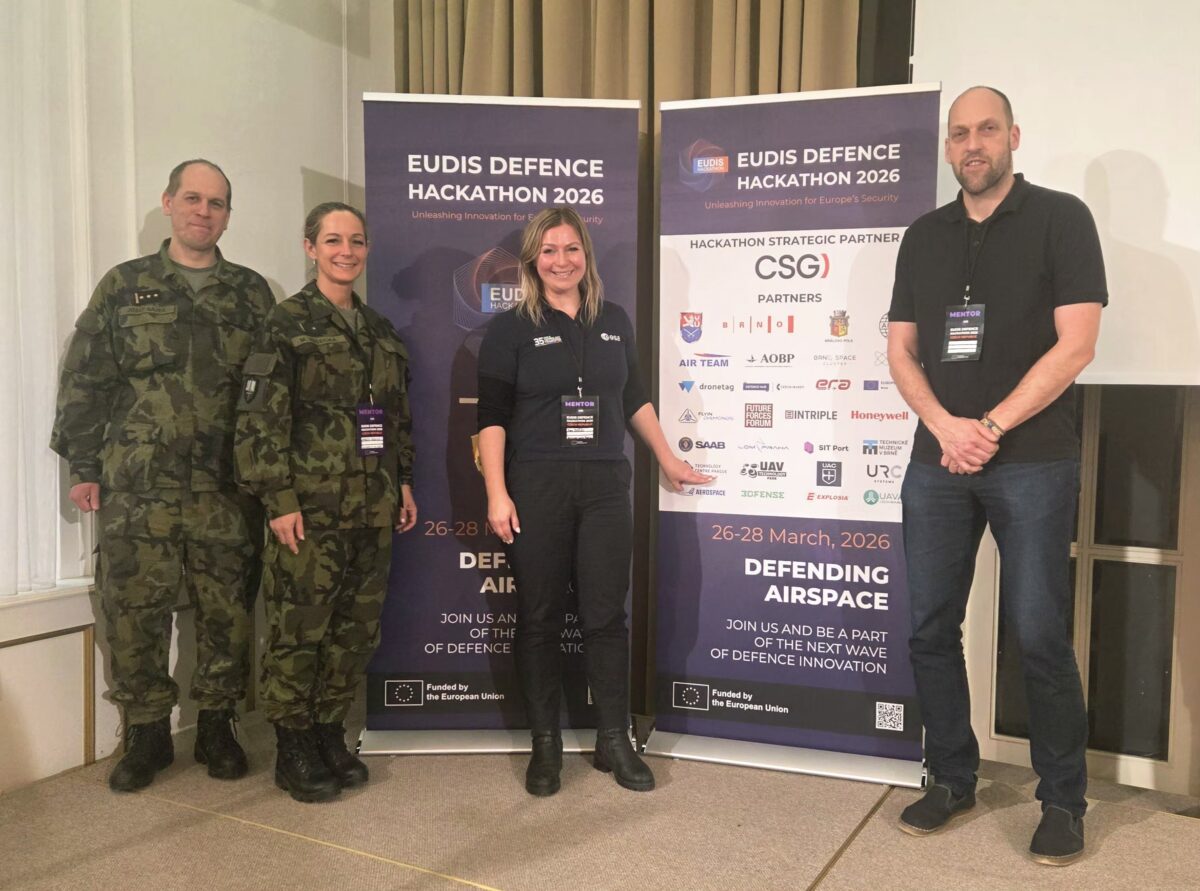
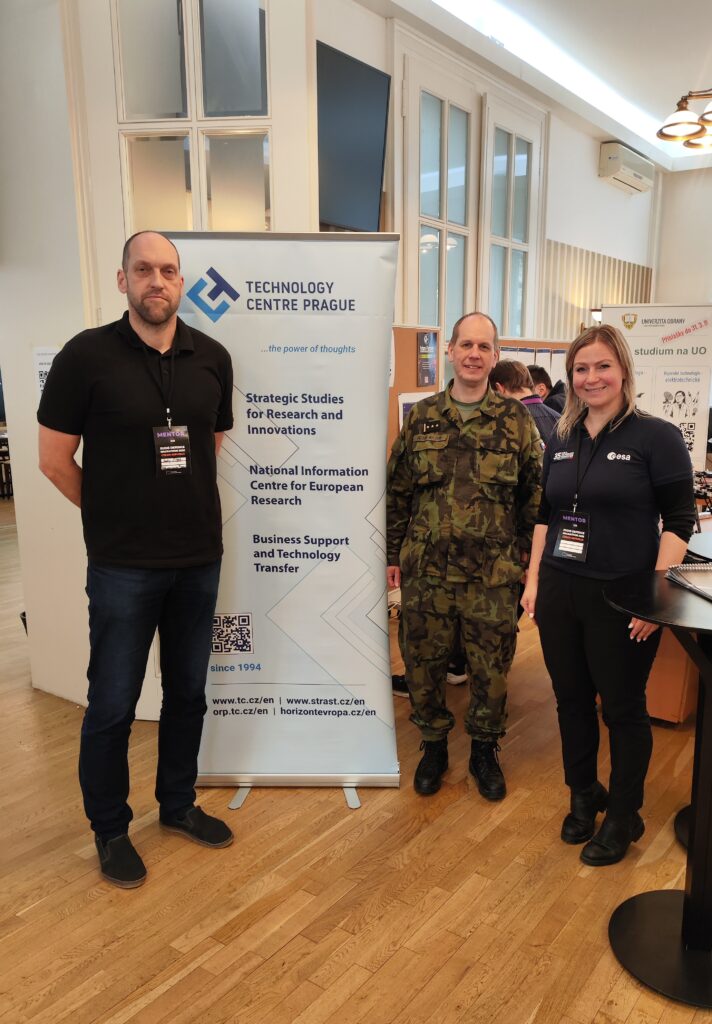
A strong contribution came from Technology Centre Prague, which joined the hackathon as both a partner and mentor. Its involvement helped strengthen the event’s expert ecosystem, which connected participants not only with defence specialists and military representatives, but also with business and innovation mentors from across the partner network. The mentorship structure in Brno was built around three main perspectives: defence and military expertise, business and innovation support, and industrial know-how from partner companies and organisations.
What made the Brno edition particularly valuable was its clear thematic structure. Teams worked across three main challenge tracks. The first focused on a cost-effective drone interceptor, addressing shortages and high operational costs in counter-UAS defence. The second challenge targeted a next-generation drone detection system, with emphasis on faster detection, identification and neutralisation. The third track explored force protection against air threats, encouraging solutions that were mobile, rapidly deployable and scalable for the protection of troops and infrastructure.
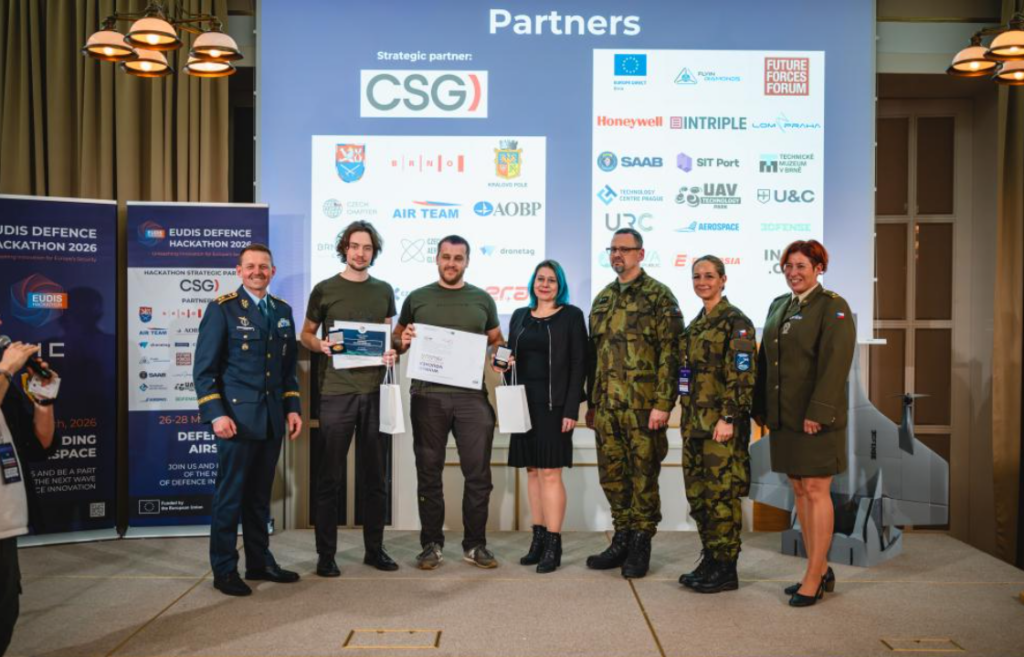
Picture from Directorate-General for Defence Industry and Space
The Czech winner of the EUDIS Defence Hackathon Spring 2026 was MALNUS, a two-person startup team developing decentralised communications, indoor localisation, and a low-cost autonomous interceptor rocket optimized for countering fibre-optic FPV drones. Their solution addressed the drone interception challenge by proposing a jamming-immune kinetic counter-UAS architecture that is rapidly deployable, operationally resilient in electromagnetically contested environments, and manufacturable at scale through 3D-printed components. In technical terms, the concept targets a critical capability gap in cost-effective terminal interception of low-signature, wire-guided aerial threats under real operational constraints.
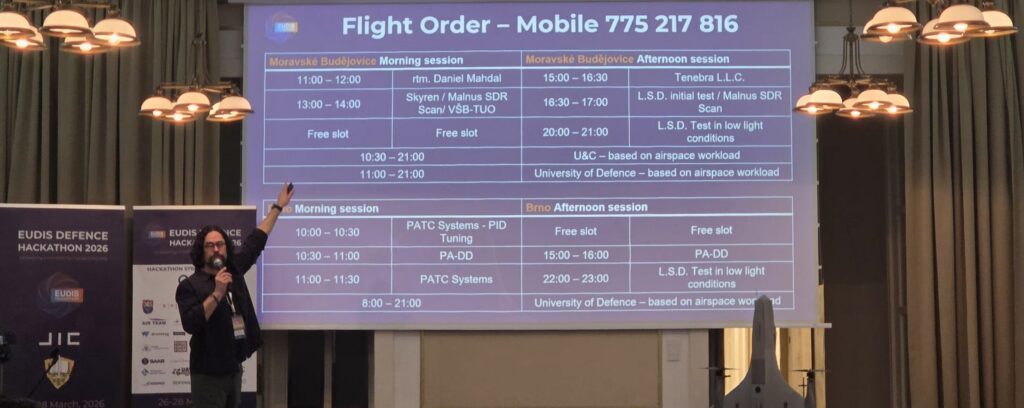
The hackathon was not limited to presentations and theory. Organisers designed it as a hands-on prototyping environment, giving participants access to multirotors, fixed-wing aircraft, acoustic measurement systems, cameras, embedded platforms, PCB manufacturing, additive manufacturing tools and measurement systems. According to the mentor materials, teams could also benefit from demonstrations involving EO/IR imaging, passive radar systems, and drone detection and jamming capabilities, while selected flight testing was planned both on site in Brno and at testing grounds in Moravské Budějovice for larger drones. This practical setup made the event especially attractive for teams working on real technical validation rather than only conceptual pitches.
Another important strength of the Brno hackathon was the breadth of organisations involved. The strategic partner was Czechoslovak Group (CSG), while the broader partner ecosystem included public institutions, defence actors, clusters, technology companies and innovation organisations. Among the listed additional partners were the Ministry of Defence of the Czech Republic, ERA, Honeywell International, Saab Technologies, Dronetag, U&C UAS, VZLU Aerospace, Czech Aerospace Cluster, Brno Space Cluster, Defence Hub CzechInvest, and Technology Centre Prague, among others. This broad coalition reinforced the practical and cross-sector nature of the event.
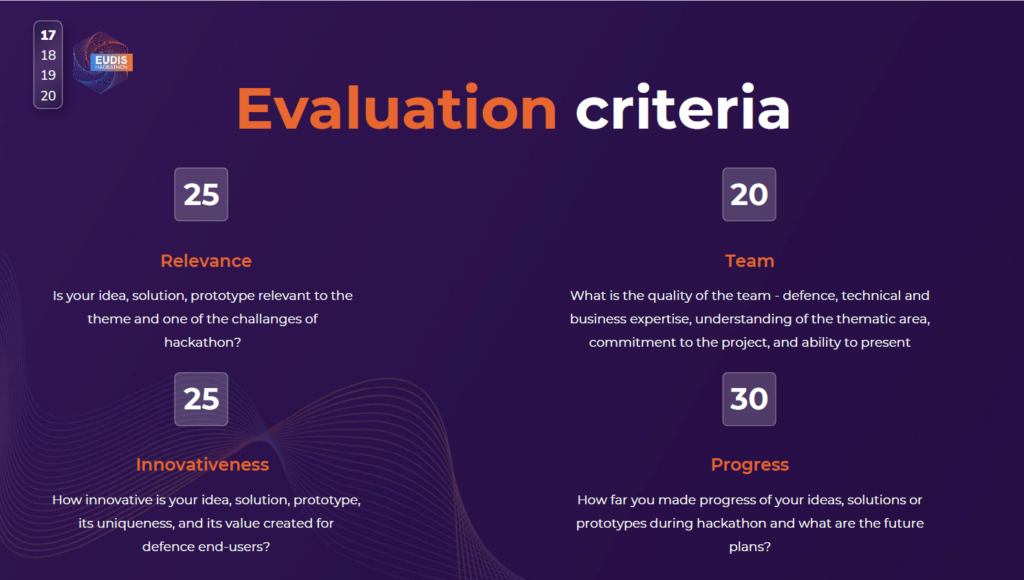
The competition was also structured around clearly defined evaluation criteria, which give useful insight into what the organisers and jury considered most valuable. Progress carried the highest weight at 30 points, rewarding teams for how far they advanced their idea, solution or prototype during the hackathon and how convincingly they outlined future development. Relevance and Innovativeness were weighted at 25 points each, highlighting the importance of fit with the hackathon theme and the originality and value of the proposed solution for defence end-users. The final 20 points were assigned to Team quality, including defence, technical and business expertise, thematic understanding, commitment and presentation skills. These criteria show that the event valued not only bold ideas, but also execution, applicability and multidisciplinary team strength.
The Czech edition also offered concrete incentives. National prizes were set at €5,000 for first place, €3,000 for second place, and €2,000 for third place. Beyond the prize money, participants were offered access to online expert workshops, continued mentoring from industry and defence experts, and an onsite bootcamp with mentors, investors and key players from the European defence ecosystem. This extended support underlined that the hackathon was designed not merely as a competition, but as a launchpad for further development.
Set in Brno, a city presented by the organisers as a Central European hub of technology, research and startups, the hackathon benefited from a venue at the University of Defence that combined collaborative space with access to mechanical and electronics labs. This helped position the Czech round as more than just another innovation event: it became a place where defence needs, engineering talent, entrepreneurial thinking and strategic mentoring could meet under one roof.
With Technology Centre Prague contributing as both partner and mentor, the Brno edition demonstrated how valuable cross-sector cooperation is in defence innovation. By combining challenge-driven teamwork, real prototyping conditions, expert mentoring and strong institutional backing, the EUDIS Defence Hackathon in Brno showed how new ideas in air defence can move faster from concept toward practical application.