
ESA Technology Broker Czechia participated in the Academia & Industry in Space Projects III workshop in Brno, organised by the Czech Space Alliance and the Institute of Scientific Instruments of the Czech Academy of Sciences. All presentations are available here.
The programme brought together universities, research institutes and companies working on space missions, scientific instrumentation, advanced materials, optics, plasma technologies and aerospace engineering. For ESA Technology Broker Czechia, the event was especially useful because many of the presented topics had a clear connection to technology transfer: highly specialised research capabilities that can be applied not only in space, but also in industrial and terrestrial applications.

A strong part of the workshop was dedicated to concrete Czech involvement in current and future space missions. One of the most practical examples was the presentation by Jan Souček from the Institute of Atmospheric Physics of the Czech Academy of Sciences, who introduced work on a Fibre Switching Actuator Unit for the LISA mission.

LISA, the Laser Interferometer Space Antenna, is ESA’s future space-based gravitational-wave observatory. The Czech contribution is linked to the Fibre Switching Unit, which enables switching to backup laser systems in the mission’s optical architecture. This is a clear example of Czech research contributing to a demanding ESA mission through precision mechanisms and optical technologies.
Another important mission-oriented topic was QUVIK, presented by Norbert Werner from Masaryk University. QUVIK, the Quick Ultra-Violet Kilonovae Surveyor, is planned as the first Czech space telescope. Its scientific goal is to observe short-lived ultraviolet signals, including kilonovae following neutron-star mergers. Masaryk University leads the scientific part of the mission, while the project is led by the Czech Aerospace Research Centre, with partners including TOPTEC and PEKASAT.
The programme also included M-MATISSE, presented by David Píša from the Institute of Atmospheric Physics of the CAS. M-MATISSE is an ESA Medium-class M7 candidate mission focused on the Martian magnetosphere, atmosphere, ionosphere and space-weather environment. The mission is currently in ESA Phase A study and is designed to improve understanding of how the solar wind interacts with Mars. For Czech research teams, this type of mission creates opportunities in plasma physics, data analysis, instrumentation and planetary exploration.
Several presentations focused on future mission concepts and enabling technologies. Timo Prusti from Masaryk University presented GaiaNIR, a future near-infrared astrometry concept building on the scientific legacy of ESA’s Gaia mission. Benedikt Bergmann from Czech Technical University introduced EXPO, a proposed M-class mission concept, and also presented RADECS 2026, an international conference on radiation effects on components and systems. RADECS is highly relevant for space electronics, radiation monitoring, dosimetry, testing and reliability of components operating in harsh environments.
The workshop did not focus only on missions. It also presented technologies that are directly useful for industry. The programme included high-resolution UV spectroscopy for future space missions by Tereza Šerábková from Masaryk University, hyperspectral cameras for atmospheric plasma observation by Martin Ferus from the J. Heyrovský Institute of Physical Chemistry, and high-enthalpy plasma spraying for functional coatings by Tomáš Tesař from the Institute of Plasma Physics of the CAS. These topics are relevant not only for space science, but also for advanced manufacturing, surface treatment, materials testing, environmental monitoring and industrial diagnostics.
The afternoon programme at the Institute of Scientific Instruments showed further practical capabilities: thermal radiative properties of space materials at cryogenic temperatures with Tomáš Králík, thermal conductivity measurements at cryogenic temperatures with Jiří Frolec, electron beam welding and vacuum brazing with Libor Dupák, femtosecond laser micromachining and spectroscopy system development with Lukáš Šilhan, and coherence optics with Jan Hrabina. These are exactly the kinds of capabilities that can support both space hardware development and non-space industrial applications.
The industry part of the programme also showed the breadth of Czech space companies. Short presentations were given by representatives of World from Space, Spacemanic, Frentech, 5M, BD Sensors, OHB Czechspace, esc Aerospace, Stratosyst and CHASM. The presence of these companies made the event useful not only as a research workshop, but also as a meeting point for possible project partners, suppliers and technology users.
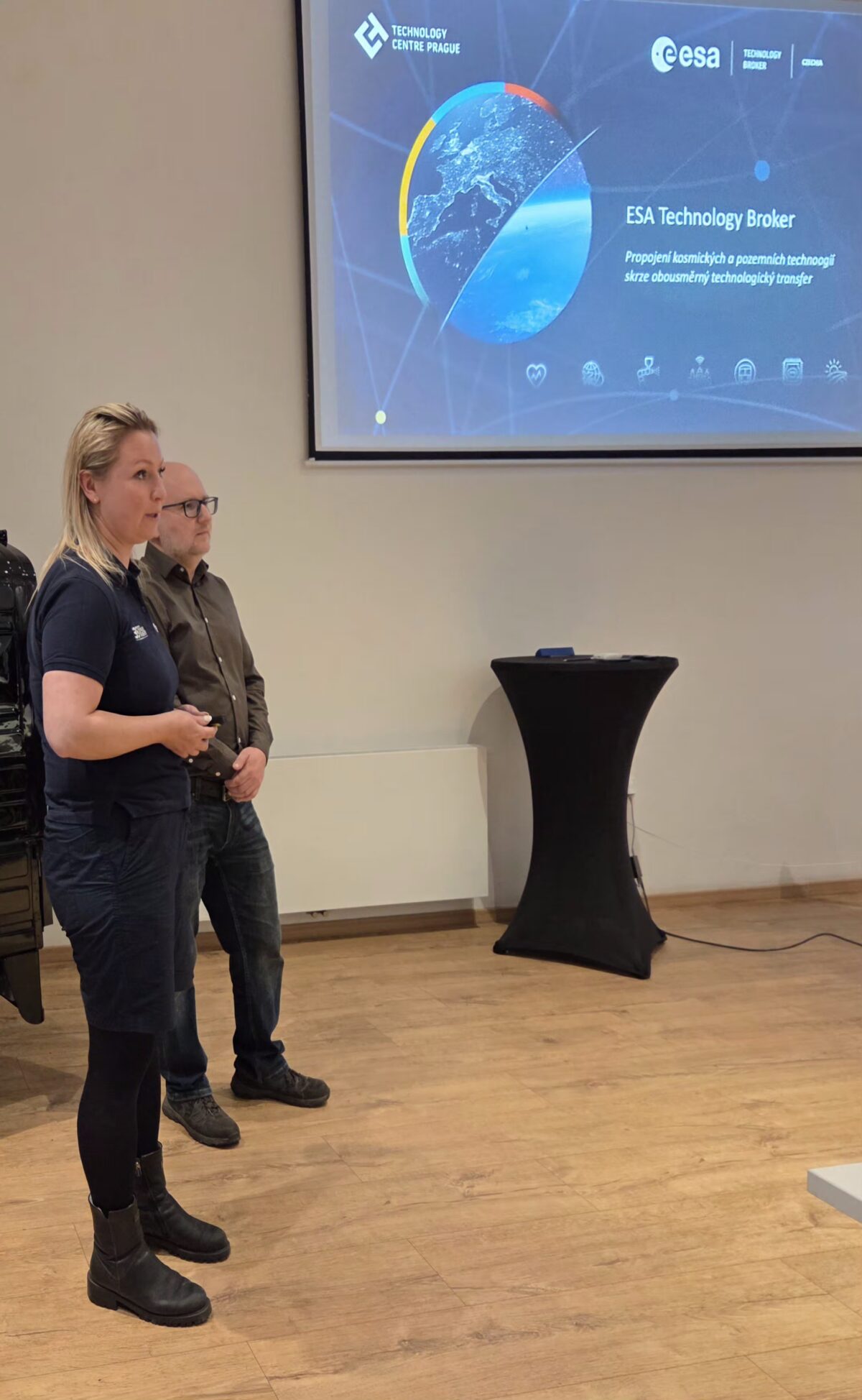
As part of the programme, ESA Technology Broker Czechia from Technology Centre Prague presented examples of academic involvement in pilot projects focused on space-terrestrial technology transfer. The presentation introduced the broker role of and highlighted how academic results can be connected with companies looking for new technical solutions, and how terrestrial technologies can also find their way into space applications.
For ESA Technology Broker Czechia, the main value of the workshop was practical: it helped identify technologies, teams and capabilities that could be developed into future cooperation. Precision optics, laser systems, cryogenic measurements, radiation testing, plasma technologies, advanced coatings, UV spectroscopy, optical communication and aerospace engineering all have strong potential for technology transfer.

The workshop confirmed that Czechia has a growing base of academic and industrial expertise relevant to space. More importantly, it showed that many of these capabilities are ready to be discussed in practical terms: as mission contributions, testing services, engineering know-how, industrial applications or pilot projects.
We would like to thank the Czech Space Alliance and the Institute of Scientific Instruments of the Czech Academy of Sciences for organising the workshop and for creating a useful meeting place for Czech academia, research organisations and industry.